
When a Truck’s Load Shifts: Understanding Alaska’s Cargo Rules and Your Right to Recover
Key Takeaways: A cargo securement violation happens when a carrier, driver, or loading crew fails to firmly immobilize freight as federal regulations require, allowing it to shift, spill, or fall during transport. Federal rules at 49 C.F.R. Part 393, Subpart I set performance standards through general requirements and commodity-specific rules for cargo like logs, metal coils, and heavy machinery. Alaska adopts much of this federal framework by reference, so intrastate haulers generally face similar securement expectations. When those rules are broken, negligence per se may help establish breach if a court adopts the regulation as the standard of care, though causation and damages must still be proven with documents such as manifests, inspection reports, hardware records, and telematics data. Responsibility can extend beyond the driver to the motor carrier, shipper, loading contractor, broker, or hardware manufacturer, and Alaska allocates fault among all responsible parties, with damages generally assessed severally. Because evidence disappears quickly and a two-year statute of limitations generally applies, early preservation and investigation are critical.
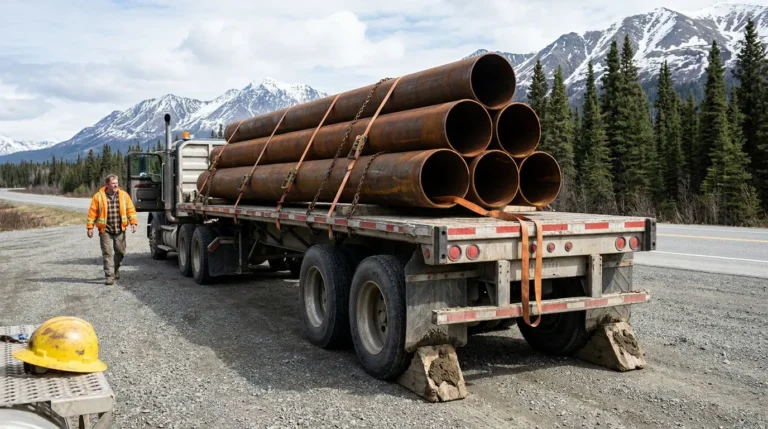
A cargo securement violation occurs when a trucking company, driver, or loading crew fails to firmly immobilize freight as federal safety regulations require, allowing it to shift, spill, or fall during transport. In an Alaska truck accident claim, these violations matter because they may help establish that the carrier breached a recognized standard of care. When logs roll off a flatbed on the Glenn Highway or building materials punch through a trailer wall during a sudden stop, the resulting crash is often the predictable consequence of skipped inspections, undersized tie-downs, or pressure to move freight faster than safety allows.
If you or someone you love suffered serious injuries because of improperly secured cargo, the team at Farnsworth & Vance is prepared to investigate what went wrong. Call 907-290-8980 or reach out to our Anchorage team to discuss your situation and learn what evidence may need to be preserved right away.
The Federal Rules That Govern How Freight Must Be Secured
Federal law sets the baseline for how commercial trucks on Alaska’s highways must restrain their loads. The FMCSA’s cargo securement rules, codified at 49 C.F.R. Part 393, Subpart I, generally require that cargo be firmly immobilized so it cannot leak, spill, blow off, shift, or fall from the vehicle. These are largely performance-based standards: the load must stay put under the deceleration and acceleration forces the rules specify, including hard braking and sharp turns.
The current framework grew out of a multi-year rulemaking effort to create uniform standards across North America. The FMCSA published its notice on the North American cargo securement standard in December 2000, addressing working load limits and performance criteria for chains, straps, and other devices. That work was later codified into Subpart I and generally applies to interstate trucking in Alaska as elsewhere, subject to built-in exemptions.
General Requirements Versus Commodity-Specific Rules
Subpart I has two layers, and both can matter in a claim. General requirements address the number of tie-downs, aggregate working load limits proportional to cargo weight, and the condition of securement devices. Layered on top are commodity-specific requirements for cargo presenting unique risks, including logs, metal coils, concrete pipe, intermodal containers, heavy machinery, and vehicles transported as freight.
That second layer can be particularly relevant in Southcentral Alaska. Much of the freight moving along the Seward Highway, the Parks Highway, and through the Port of Alaska consists of timber products, construction materials, equipment bound for remote job sites, and seafood in refrigerated trailers. Each category carries its own restraint profile. A load of logs secured as though it were lumber may satisfy a general rule while violating the commodity-specific standard that actually applies.
How State Regulation Intersects With Federal Standards
Alaska does not appear to operate an entirely separate cargo securement regime. Like most states, Alaska adopts substantial portions of federal motor carrier safety regulations by reference. Commercial motor vehicle provisions appear within Alaska Administrative Code Title 13, while size, weight, and highway-use provisions are administered separately by the Department of Transportation and Public Facilities. The practical effect is that a carrier hauling freight entirely within Alaska generally faces securement expectations similar to those governing an interstate hauler, though the scope of adoption and any state-specific exemptions should be confirmed against current regulatory text.
This matters for a practical reason injured people often overlook. A defendant carrier may argue that because a haul never crossed a state line, federal rules do not apply. Whether that argument holds depends on how applicable state provisions adopt federal standards and on the specific operation at issue. These questions are fact-dependent, and careful review of the carrier’s operating authority, vehicle classification, and route is generally necessary before drawing conclusions. Even where a regulation does not apply of its own force, industry standards and expert testimony may still inform the standard of care.
Proving Cargo Securement Violations Truck Accident Claims Depend On
Negligence per se is the doctrine most often invoked when a safety regulation is violated. Alaska courts follow the Restatement (Second) of Torts approach, under which a court has discretion to adopt a statute or regulation as the standard of care where the rule was designed to protect a class of people from the particular type of harm that occurred. When a court does so, an unexcused violation establishes breach rather than requiring the plaintiff to prove what a reasonable carrier would have done. Courts apply the doctrine carefully, the violation may be excused in certain circumstances, and its availability depends on the regulation’s purpose and whether the harm is the type the rule was meant to prevent. Even where negligence per se applies, a plaintiff must still prove causation and damages.
Documentary evidence usually drives these cases far more than eyewitness accounts. Loads shift in seconds, and by the time responders arrive, physical evidence may be scattered across a highway shoulder. Records that tend to matter most include:
- Bills of lading, weight tickets, and load manifests showing what was hauled and how much it weighed
- Loading records and photographs taken at the shipper’s facility or terminal
- Driver vehicle inspection reports and pre-trip inspection documentation
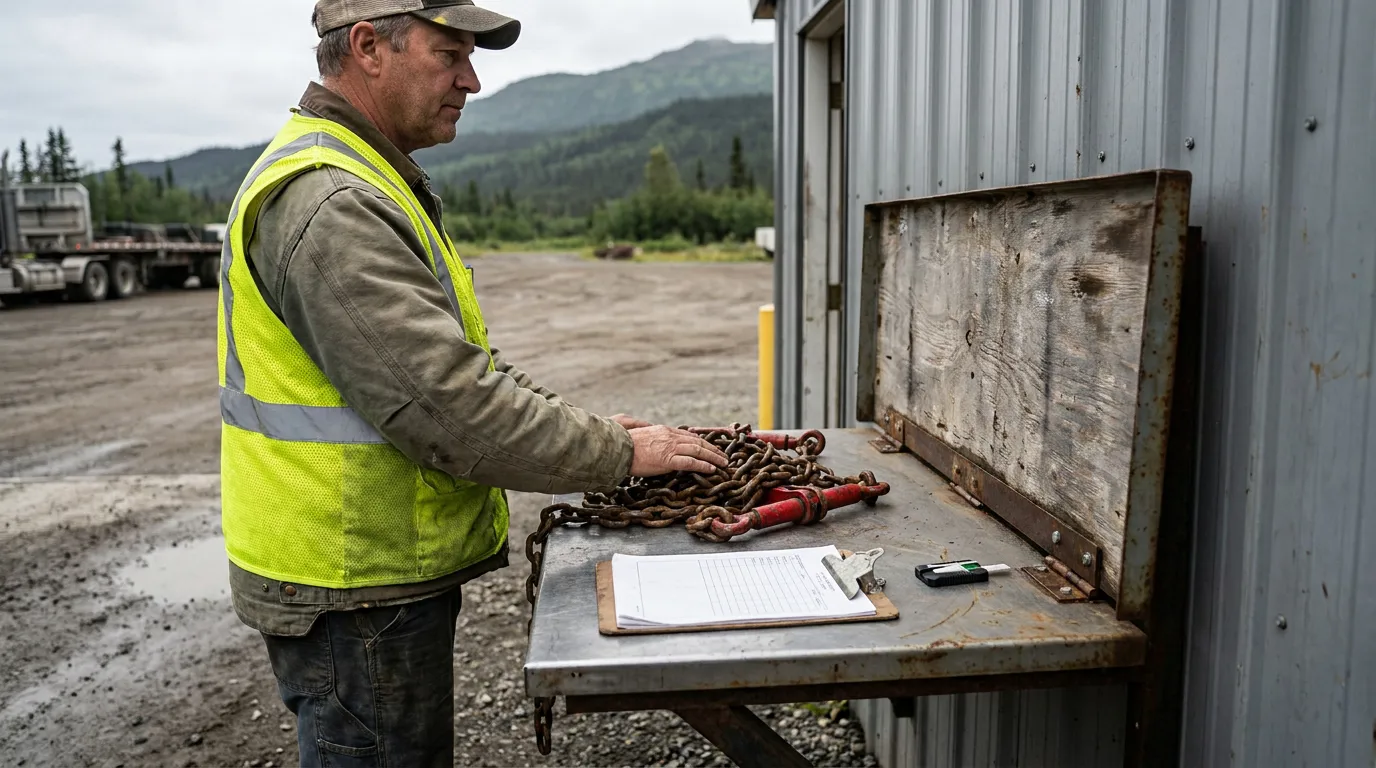
- Purchase and maintenance records for straps, chains, binders, and winches
- Electronic logging device and telematics data showing braking, speed, and route
- Post-crash inspection reports and out-of-service determinations
Federal crash reporting provides useful context for how these failures fit into the broader safety picture. The FMCSA maintains a national database of reportable large truck and bus crashes, allowing analysis of factors including shifting or falling cargo. National data does not prove any individual case, but it helps frame why securement compliance is treated as a serious safety obligation rather than paperwork.
\u{1F4A1} Pro Tip: Securement hardware is often discarded, repaired, or returned to service within days of a crash. A written preservation letter sent early to the carrier, shipper, and any third-party loading company may help prevent the loss of straps, chains, and load records that later become central to proving a truck cargo violation.
Who May Bear Responsibility Beyond the Driver
Responsibility for a cargo shift injury rarely stops with the person behind the wheel. Depending on the facts, potentially responsible parties may include the motor carrier that dispatched the load, the shipper or warehouse that loaded and sealed the trailer, a third-party loading contractor, a broker that arranged the haul, and in some situations the manufacturer of defective securement hardware. Alaska uses pure comparative fault, so a claimant’s own fault reduces but does not bar recovery, and fault is apportioned among the parties. Under Alaska’s several liability statute, each defendant is generally responsible only for its own allocated share of damages, subject to limited exceptions such as vicarious liability.
Sealed-trailer arrangements create a recurring dispute. Carriers frequently argue that a driver could not inspect a load sealed by the shipper. Federal rules recognize limits on a driver’s inspection duty where a vehicle has been sealed, but securement obligations may still attach to the carrier’s operation of the vehicle. Whether a sealed-load defense succeeds generally depends on the contractual arrangement, the driver’s actual opportunity to inspect, and the nature of the securement failure.
| Category of Failure | Typical Example | Records That Often Matter |
|---|---|---|
| Insufficient tie-downs | Fewer restraints than cargo length and weight require | Manifests, weight tickets, scene photos |
| Inadequate working load limit | Straps rated below the aggregate requirement | Hardware specifications, purchase records |
| Degraded equipment | Frayed webbing, cracked chain links, worn binders | Inspection reports, maintenance logs |
| Improper weight distribution | Load placed too high or unevenly across the deck | Loading records, terminal video |
| Commodity rule disregard | Logs or coils restrained under general rules only | Bills of lading, carrier training materials |
Common Obstacles Injured Alaskans Encounter
Insurance carriers often respond to these claims quickly and aggressively. Commercial trucking insurers may dispatch rapid response teams to serious crash scenes, sometimes before an injured person has left the hospital, photographing and interviewing while the claimant is still in surgery. That imbalance is one reason many people benefit from getting counsel involved early, and our blog covers Alaska trucking negligence topics in greater depth.
Alaska’s geography adds complications that do not arise in most states. Crashes on remote highway stretches may involve delayed emergency response, limited scene documentation, and weather that destroys physical evidence within hours. Winter conditions may also give defendants a ready argument: that ice, not securement failure, caused the loss of control. Establishing that a load shifted before a vehicle lost traction often requires reconstruction analysis of the trailer’s behavior, tire marks, and debris distribution.
Timing limits apply and should not be assumed flexible. Alaska generally imposes a two-year statute of limitations on personal injury claims under AS 09.10.070, and wrongful death actions are generally subject to a two-year period under AS 09.55.580. Doctrines like the discovery rule and tolling for minors or incapacity may affect when a claim accrues, but courts often interpret such exceptions narrowly. Claims against government entities in Alaska generally follow the same two-year statute of limitations as other personal injury claims, and Alaska does not impose a short pre-suit notice of claim requirement for injury lawsuits against the state or municipalities.
\u{1F4A1} Pro Tip: If you retained any physical items from the scene, store them without cleaning or repairing them. Altered items can lose evidentiary value, and defense engineers routinely challenge the reliability of anything that has been modified.
What Investigation Typically Involves
A thorough securement investigation moves on several tracks at once. Counsel may inspect the tractor and trailer before repairs, retain a reconstruction engineer, request the carrier’s safety rating and inspection history, and depose the driver, the loading crew, and the carrier’s safety director. Comparing what the carrier’s own training materials required against what actually happened can often reveal the clearest picture of breach.
Commercial truck cargo safety obligations may also extend to carrier systems, not just individual loads. If a carrier failed to train drivers on commodity-specific restraint requirements, lacked a hardware inspection program, or ignored prior violations flagged during roadside inspections, those failures may support direct claims against the company for negligent training, supervision, or entrustment. Whether such claims are available depends on the evidence developed and on whether the carrier has admitted the driver was acting within the scope of employment.
Frequently Asked Questions
1. Does a citation issued at the scene prove the trucking company was negligent?
Not automatically. A citation or out-of-service order may be persuasive evidence of a securement failure, but its weight depends on evidentiary rules and the case’s procedural posture, and a citation alone is generally not conclusive proof of civil liability. Conversely, the absence of a citation does not necessarily establish compliance, since roadside officers may not conduct a full securement audit after a serious crash.
2. What if the shipper loaded and sealed the trailer without the driver present?
That fact may shift some responsibility toward the shipper or loading contractor, but it does not necessarily eliminate the carrier’s obligations. The analysis generally turns on the contract terms, whether the driver had a realistic opportunity to inspect, and the nature of the defect. Multiple parties may share responsibility under Alaska’s comparative fault framework.
3. Can I recover if I was partially at fault for the collision?
Alaska follows pure comparative fault, which generally allows recovery reduced in proportion to a claimant’s own share of responsibility, even if that share is substantial. Because fault allocation is highly fact-dependent and frequently contested, an early assessment of the evidence is useful. Insurers may overstate a claimant’s share during initial negotiations.
4. How soon should evidence preservation begin after a cargo-related crash?
As soon as practical. Electronic data may be overwritten, trailers are often returned to service, and securement hardware may be replaced within days. Prompt preservation demands can be the difference between a documented violation and an unprovable theory.
5. Do federal securement rules apply to a truck that never leaves Alaska?
Often, yes, because states generally adopt federal standards by reference for intrastate commercial operations. The precise application depends on the state provisions governing the carrier, any state exemptions, and the nature of its operation, which should be assessed case by case.
Moving Forward After a Load Failure Crash
Cargo securement violations sit at the intersection of engineering, regulation, and human decision-making. Federal rules establish measurable obligations concerning tie-down counts, working load limits, and commodity-specific restraint methods, and Alaska’s regulatory framework generally incorporates those expectations for commercial operations within the state. When those obligations are ignored, the consequences for people in passenger vehicles can be catastrophic. Proving what happened, however, generally requires fast action, methodical document collection, and a clear understanding of how negligence principles may apply to regulatory breaches. Outcomes always depend on the specific facts, and no two load failure cases develop identically.
If improperly secured freight caused your injuries or took a family member’s life, Farnsworth & Vance can help you understand your options. Speak with an Anchorage truck accident lawyer by calling 907-290-8980, or start your case review today to get answers about your Alaska truck accident claim.
Disclaimer: This content is for informational purposes only and is not legal advice. Every case is unique, and results may vary. Consult an attorney about your specific circumstances.