
Who Pays When a Truck Tire Fails on an Alaska Highway?
Key Takeaways: Yes, you may be able to sue a tire manufacturer after an 18-wheeler blowout crash in Alaska if a manufacturing defect, design defect, or failure to warn caused the tire to fail. The trucking company, the driver, a repair shop, or a retread facility may also share responsibility. Alaska generally uses several liability, so each defendant usually pays only its own share of fault, which makes it important to name every responsible party. Most injury and property damage claims must be filed within two years under AK § 09.10.070, though other deadlines can apply to some claims. The 10-year statute of repose generally does not apply to claims based on a defective product like a tire. Under Alaska’s pure comparative fault rule, your own fault reduces your award but does not bar recovery. Keeping the failed tire and gathering technical evidence early can make your case much stronger.
Yes, you may be able to sue a tire manufacturer after an 18-wheeler blowout crash in Alaska, and the manufacturer may not be the only party you can sue. When a semi truck tire fails at highway speed, the driver can lose control in seconds, and debris can strike nearby vehicles. If the tire failed because of a design flaw, a manufacturing defect, or missing warnings, the company that made it, and possibly others that sold it, may be legally responsible. The trucking company, a maintenance shop, or a retread facility may share that responsibility.
If you or someone you love was hurt in a blowout crash, you do not have to sort through these questions alone. The team at Farnsworth & Vance handles commercial truck accident claims for injured Alaskans and their families. Call 907-290-8980 or contact us now to talk about your situation.
How a Defective Tire Can Cause a Serious Crash
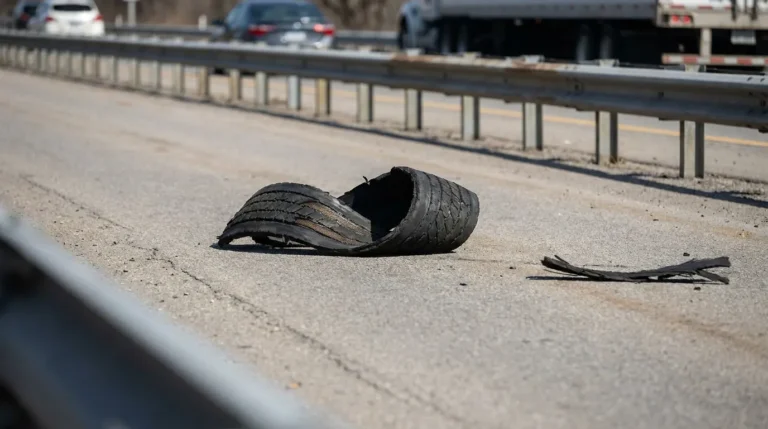
Tires on commercial trucks carry huge loads, so a single failure can cause a multi-vehicle collision. One common failure is tire tread separation, where the tread peels away from the casing, often with little warning. A sudden loss of air pressure can also make a loaded trailer swerve, jackknife, or roll over.
Not every blowout comes from a defect, and that difference shapes the whole case. Some tires fail because a carrier underinflated them, overloaded the trailer, or kept a worn tire in service. Others fail because of a flaw that existed before the tire left the factory. The National Highway Traffic Safety Administration publishes tire safety and recall information. Recall records can sometimes help show a known problem, but a recall alone does not prove that a particular tire was defective or caused a crash.
Types of Tire Defects That May Support a Claim
Product liability truck tire claims usually rest on one or more types of defect:
- Manufacturing defect: The tire left the plant different from its intended design, such as through contaminated rubber, poor bonding between layers, or misplaced steel belts.
- Design defect: Every tire built to the design carries the same risk, for example if it lacks features that would prevent tread separation.
- Failure to warn: The manufacturer did not give adequate warnings about load limits, age, or inflation risks.
Strict Liability Versus Negligence
Some product claims do not require proof of carelessness. Alaska recognizes strict product liability, so injured people may bring claims against manufacturers and others in the chain of distribution based on the product’s defective condition, not the company’s conduct. You still generally must prove that the defect existed and caused your injuries. Learning the difference between strict liability and negligence can help you see how these claims work. Claims against a trucking company usually depend on proving negligence, such as poor inspections or ignoring worn tires.
Who May Share Responsibility in a Truck Tire Blowout Accident
A defective tire claim often involves more than one defendant. Under AK § 09.17.080(a)(2), when more than one party is at fault, the jury or judge generally assigns a percentage of total fault to each claimant, defendant, third-party defendant, released party, or other responsible person. Fault generally cannot be assigned to a nonparty who could have been added to the lawsuit but was not. Depending on the facts, responsible parties may include:
| Potentially Responsible Party | Possible Basis for Liability |
|---|---|
| Tire manufacturer | Design defect, manufacturing defect, or inadequate warnings |
| Motor carrier / truck owner | Poor inspection, maintenance, or overloading |
| Truck driver | Ignoring warning signs or skipping pre-trip inspections |
| Repair or retread shop | Faulty retreading, mounting, or repair work |
The jury does not split fault evenly by default. Under AK § 09.17.080(b), the jury or judge may consider both the nature of each party’s conduct and how closely that conduct is connected to the harm. Maintenance logs, inspection reports, and the physical tire can shape how those percentages fall.
Why Naming Every Responsible Party Matters
Alaska generally uses several liability, which means each defendant usually pays only its own share of fault. AK § 09.17.080(d) directs the court to enter judgment against each liable party based on its percentage of fault. There are exceptions. For example, a motor carrier may be held responsible for its employee driver’s fault. If fault is assigned to a responsible person who is not a defendant, you generally cannot collect that share from any other defendant. That is why a thorough semi truck blowout lawsuit often names both the manufacturer and the motor carrier, along with any shop involved.
💡 Pro Tip: Ask that the failed tire and all of its pieces be kept. The tire is often the most important evidence, and carriers or tow companies may throw it away if no one asks them to keep it.
Alaska Filing Deadlines You Cannot Afford to Miss
In most cases, Alaska gives injured people two years to file a lawsuit. Under AK § 09.10.070(a)(2), an action for personal injury or death not arising on contract must be filed within two years of when the claim accrues. Under AK § 09.10.070(a)(3), the same limit generally applies to damage to personal property, such as a car or cargo destroyed in the crash. Wrongful death actions under AS 09.55.580 generally must be filed within two years after the death, and contract-based warranty claims may have a different deadline.
Some limited situations may extend or delay the deadline. Alaska law includes tolling provisions, such as AS 09.10.140 for minors and persons who are incompetent. The discovery rule may also affect when the clock starts. These exceptions have specific requirements, and none applies automatically. Treat the two-year date as your working deadline.
The 10-Year Statute of Repose and Its Product Exception
Alaska also has a separate, hard cutoff called a statute of repose. Under AK § 09.10.055(a), a person generally may not bring an action for personal injury, death, or property damage unless it is filed within 10 years of the earlier of substantial completion of the construction alleged to have caused the harm or the last act alleged to have caused the harm. This cutoff runs separately from the two-year limit.
The 10-year cutoff generally does not apply when the injury came from a defective product. AK § 09.10.055(b)(1)(E) defines a product as an object that has intrinsic value, can be delivered as an assembled whole or as a component part, and is introduced into trade or commerce. A truck tire likely fits that definition, so the tire’s age alone generally will not bar a defective-product claim. The two-year limit still applies. Claims not based on a defective product, such as negligent maintenance claims, may still be subject to the repose period.
Other exceptions may matter too. Under AK § 09.10.055(b)(1)(B)-(D) and (b)(2), the cutoff also does not apply to claims involving an intentional act or gross negligence, fraud or misrepresentation, breach of an express warranty or guarantee, or intentional hiding of facts that would have given notice of a possible claim.
How Your Own Fault Affects Your Recovery
Alaska follows pure comparative fault, so partial fault does not end your claim. Under AK § 09.17.060, your own share of fault reduces your damages award but does not bar recovery. If a jury found you 20% at fault for following too closely, your award would generally drop by 20%.
Insurers sometimes blame injured drivers to lower what they pay. A careful investigation can help push back against unfair blame, using inspection records, electronic logging data, black-box data, and tire analysis.
💡 Pro Tip: Avoid giving recorded statements to a trucking company’s insurer before you understand your rights. Casual comments about speed or what you noticed may later be used to argue that you share fault.
Building a Strong Tire Manufacturer Liability Case
Proving tire manufacturer liability generally depends on technical evidence gathered quickly. Useful evidence may include the failed tire, its DOT tire identification number, purchase and retread records, carrier maintenance files, FMCSA inspection reports, and recall history. Engineers and tire experts may examine the casing to tell a factory defect apart from damage caused by misuse, underinflation, or road hazards.
An experienced truck accident lawyer can help you keep that evidence before it disappears. Every case turns on its own facts, and no outcome is guaranteed. Still, an early investigation can help find every responsible party.
Frequently Asked Questions
1. Can I sue if the tire was more than 10 years old?
Possibly. Under AK § 09.10.055(b)(1)(E), the 10-year statute of repose generally does not apply to claims based on a defective product, and a tire likely counts as a product. You generally still must file within the two-year limit. The defense may use the tire’s age to argue that wear or misuse caused the failure.
2. How long do I have to file a defective truck tire lawsuit in Alaska?
In most cases, two years from when the claim accrues under AK § 09.10.070(a)(2). Wrongful death and warranty claims may follow different rules.
3. What if I was partly at fault for the crash?
Under AK § 09.17.060, your own fault does not bar recovery. Your damages are reduced by your percentage of fault.
4. Can I sue both the trucking company and the tire manufacturer?
Yes, in many cases. Because AK § 09.17.080(d) generally applies several liability, naming every responsible party can affect how much you recover.
5. Can I recover for my damaged vehicle?
In many cases, yes. AK § 09.10.070(a)(3) generally applies the same two-year limit to claims for damage to personal property.
Protecting Your Rights After an 18-Wheeler Blowout Crash
A truck tire blowout accident may give you claims against the tire manufacturer, the carrier, and others whose choices played a part. In most cases, Alaska law gives you two years to file. The product exception may keep claims involving older tires alive, and pure comparative fault keeps your claim open even if you share some blame. Because each defendant generally pays only its own share, a thorough investigation matters from the start.
Help is available when you are ready to explore your options. Reach out to Farnsworth & Vance at 907-290-8980, or schedule your consultation today to discuss your blowout crash.
Disclaimer: This content is for informational purposes only and is not legal advice. Every case is unique, and results may vary. Consult an attorney about your specific circumstances.


