
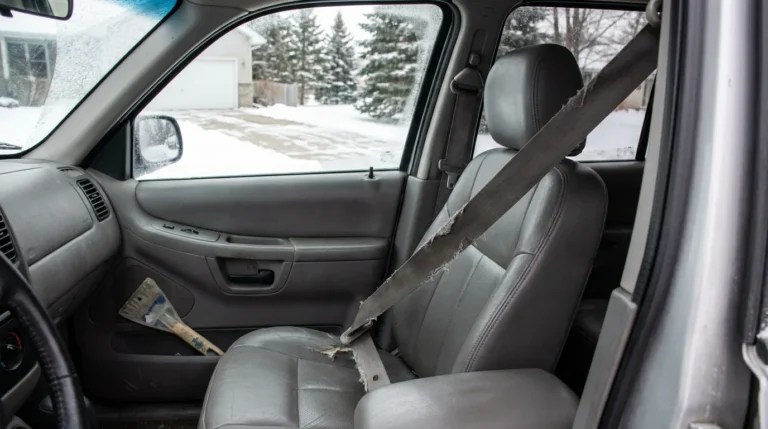
Why Insurers Bring Up Your Seat Belt After an Alaska Crash
Key Takeaways: The seat belt defense in an Alaska car accident claim is an insurer’s attempt to reduce compensation by pointing to a plaintiff’s failure to buckle up. Under a 1986 Alaska Supreme Court ruling, that evidence generally goes to the amount of damages rather than who caused the collision. A defendant generally must show a reasonably prudent person would have worn the available seat belt, that the restraint system worked, that it went unused, and that nonuse made identifiable injuries more severe, often requiring biomechanical or accident reconstruction testimony. Alaska’s pure comparative negligence system under AS 09.17.060 separately governs fault for the collision itself. In practice, the argument often surfaces in negotiations as leverage for a lower offer rather than in court. Preserving the vehicle, gathering documentation early, maintaining consistent medical treatment, and acting within the general two-year statute of limitations may all help protect the value of a claim.
If you were hurt in a collision and an adjuster keeps asking whether you were buckled up, you may be encountering what lawyers call the seat belt defense. In Alaska, a defendant generally cannot use your failure to wear a seat belt to claim you caused the crash. Alaska law generally limits that evidence to whether buckling up would have reduced the severity of your injuries, a distinction that may shape how much of your claim is actually at risk.
If an insurance company is pointing to seat belt nonuse to justify a reduced settlement, the team at Farnsworth & Vance can review your Alaska crash injury damages and explain your options. Call 907-290-8980 or contact us now to discuss what happened.
How the Seat Belt Defense Alaska Car Accident Rule Developed
Alaska’s approach traces back to a 1986 Alaska Supreme Court decision, Hutchins v. Schwartz. There, the court held that if a reasonably prudent person would have used a seat belt under the circumstances, and the plaintiff suffered more severe injuries as a result of not wearing one, a jury may consider that factor in assessing damages. The court framed the issue as one of damages, not proof that the plaintiff caused the collision.
The reasoning behind the Alaska Supreme Court seat belt ruling is intuitive: failing to buckle up does not cause a collision, but it may increase how badly someone is hurt once one occurs.
Notably, in Hutchins itself the trial court ultimately directed a verdict against the defendant on the seat belt issue and told the jury to disregard the evidence, because the defense had not shown the restraint system actually worked or that nonuse caused the injuries. That illustrates how much the defense depends on proof. This ruling remains Alaska precedent, though how a specific judge handles the evidence depends on the facts, proof offered, and procedural posture of the case.
Where the Statutes Fit In
Alaska’s seat belt requirements appear in Title 28 (Motor Vehicles), Chapter 28.05 (Administration), Article 2. AS 28.05.095 requires seat belt use by occupants 16 and older and sets child restraint requirements, subject to listed exemptions, while AS 28.05.099 sets penalties for violations. Neither section is a civil-admissibility statute; use of seat belt nonuse evidence in a personal injury case is governed by case law and the rules of evidence.
Because statutory text is periodically amended and recodified, current versions of Alaska Statutes should be confirmed through the Alaska State Legislature’s official BASIS system.
Why Comparative Fault Alaska Rules Still Matter
Alaska follows a pure comparative negligence system codified at AS 09.17.060, which directs that damages be reduced by the claimant’s own percentage of fault rather than barred outright. This is the backdrop against which any seat belt argument gets evaluated.
Seat belt nonuse and fault for causing the collision are generally not treated as the same thing in Alaska. Comparative fault addresses who caused the collision, while seat belt evidence, under the 1986 holding, generally addresses only whether some portion of the resulting harm could have been avoided. Courts in other contexts, such as product liability claims involving misuse of a restraint, may analyze seat belt conduct differently.
What a Defendant Generally Must Show
Raising the seat belt defense is not as simple as asking whether you were buckled. A defendant generally carries the burden of demonstrating that a working seat belt was actually available, that a reasonably prudent person would have used it, and that nonuse contributed to the severity of specific injuries. Bare speculation typically does not satisfy that burden, and Hutchins shows a court may strike the evidence entirely when proof is lacking.
In many cases, that proof requires technical testimony. Biomechanical or accident reconstruction analysis may be offered to connect the absence of a restraint to particular injuries. Whether a court admits that testimony, and how persuasive a jury finds it, varies considerably.
Elements a defense typically attempts to establish include:
- That a functioning seat belt was available at the time
- That the person did not use it
- That proper use would have reduced or prevented identifiable injuries
- A reasonable basis for quantifying damages attributable to nonuse
Each of those elements may be contestable. Vehicle damage, restraint system defects, seating position, crash dynamics, and medical evidence can all potentially undercut a nonuse argument. Preserving the vehicle and obtaining complete medical records early tends to matter a great deal here.
💡 Pro Tip: Do not repair or dispose of your vehicle before it has been photographed and inspected. The condition of the restraint system itself can often be a strong rebuttal to a seat belt argument.
How This Plays Out in a Car Accident Claim Alaska Insurers Handle
In many cases, the seat belt issue never reaches a courtroom. It often surfaces during negotiations, when an adjuster uses it to justify a lower offer. Many insurers understand claimants may not know the legal boundaries of this argument, and some treat the mere mention of it as leverage.
Recognizing that leverage for what it is can change the conversation. Understanding insurance company tactics after a crash may help injured people avoid conceding more than the law requires. An adjuster’s characterization of Alaska law is not the same as a court’s ruling on admissibility.
| Issue | What Alaska Law Generally Permits |
|---|---|
| Fault for causing the collision | Seat belt nonuse generally does not show who caused the crash |
| Defendant’s liability | Seat belt nonuse generally does not bear on whether the defendant was negligent |
| Severity of resulting injuries | Nonuse may be considered in assessing damages if supported by proof |
| Apportioning crash fault | Generally governed by pure comparative negligence under AS 09.17.060 |
This table simplifies a nuanced area of law. Individual rulings depend on the evidence presented and arguments preserved.
How Other States Compare
Alaska’s middle-ground approach is far from universal. Courts and legislatures across the country have taken varied positions, with many states barring use of the seat belt defense entirely, a minority permitting a damages reduction, and others limiting evidence of nonuse to narrow circumstances such as product liability claims.
That variation is why out-of-state information can mislead Alaska readers. A blog post describing the rule in another state may have no application to a claim arising in Anchorage or Eagle River. Generally, Alaska statutes and appellate decisions control claims filed here.
Fault apportionment principles remain foundational to Alaska tort practice, appearing consistently in Alaska Bar admissions materials on torts, reflecting how central negligence, comparative fault, and damages analysis are to practice in this state.
Practical Steps That Protect an Alaska Injury Claim Defense
Documentation tends to be the difference between a contested argument and a resolved one. Photographs of the vehicle interior, the police report’s restraint notations, witness statements, and emergency medical records can all bear on whether a seat belt was used and whether it functioned. Waiting to gather these items often means losing them.
Medical treatment records may carry particular weight. Consistent, documented care can help tie specific injuries to the collision and may make it harder for a defendant to attribute harm to nonuse rather than impact forces. Gaps in treatment may give insurers room to argue otherwise.
💡 Pro Tip: Be accurate in every statement you give. Inconsistent accounts of whether you were belted can damage credibility on unrelated parts of your claim.
Timing also matters. Alaska’s statute of limitations for most car accident lawsuits is generally two years from the date of injury under AS 09.10.070. Claims against the State or local government entities generally follow the same two-year statute of limitations under AS 09.10.070 and AS 09.50.250, and Alaska does not impose a separate short pre-suit administrative notice requirement for injury lawsuits against government entities. Limited exceptions, including tolling for minors or incapacity and the discovery rule, may apply, but they are fact-specific.
When to Involve Counsel
Because seat belt arguments intersect with medical causation, accident reconstruction, and damages calculation, they can be difficult to evaluate without the underlying records. An experienced Anchorage car accident lawyer can assess whether a defendant’s nonuse argument has evidentiary support or is simply a negotiating posture. Outcomes depend on the specific facts.
Frequently Asked Questions
1. Can my Alaska claim be denied entirely because I was not wearing a seat belt?
Generally, no. Under the 1986 Alaska Supreme Court holding, seat belt nonuse goes to the amount of damages, not to whether the defendant was negligent or who caused the collision. Even as to damages, the defendant would generally need evidence that a prudent person would have belted and that nonuse worsened specific injuries.
2. Does Alaska’s mandatory seat belt law automatically prove I was negligent?
Not automatically. AS 28.05.095 imposes seat belt obligations and AS 28.05.099 sets penalties for violating them, but whether nonuse reduces civil damages is governed by Alaska case law and the rules of evidence. A traffic infraction and a civil damages reduction are generally distinct questions.
3. How much can a seat belt argument reduce my recovery?
There is no fixed percentage. Any reduction would generally depend on evidence showing which specific injuries proper restraint use would have prevented or lessened. Because that proof is fact-intensive and often disputed, the practical effect varies widely.
4. What if the seat belt was broken or unavailable?
The 1986 ruling turned in part on whether the restraint system actually worked; the defense there failed for lack of such proof. If a restraint was defective, inaccessible, or nonfunctional, that circumstance may weaken or eliminate the argument. Preserving the vehicle for inspection can be important in these situations.
5. Should I discuss seat belt use with an adjuster before speaking with an attorney?
You are generally not required to give a recorded statement to another driver’s insurer. Because casual answers may be used to support defense tactics in a car accident claim, many injured people prefer to have counsel review the request first.
Protecting the Full Value of Your Claim
The Alaska seat belt defense is generally narrower than insurers often suggest. Alaska law generally allows evidence of seat belt nonuse to affect the damages calculation, not the question of who caused the collision or whether the defendant is liable. Combined with Alaska’s pure comparative negligence framework under AS 09.17.060, this means a seat belt argument may limit, rather than eliminate, a claim. How much it limits anything generally depends on the evidence, and that evidence is frequently contestable.
If an insurer is using seat belt nonuse to push a lower number, reach out to Farnsworth & Vance by calling 907-290-8980 or schedule a consultation today. You can also learn more about the firm’s Alaska personal injury practice before deciding how to proceed.
Disclaimer: This content is for informational purposes only and is not legal advice. Every case is unique, and results may vary. Consult an attorney about your specific circumstances.


